Espy is a biannual photography award in conjunction with Elysium Gallery Swansea. Set up by Dan Staveley, professional photographer and lecturer,
Espy wants to show photography at its best, both online and in the print competition. The award is judged by highly respected professionals such as
Richard Billingham and Iain Davies, who awarded the prizes for 2014.
Thanks goes to Nicole Mawby for building and maintaining the blog.

Monday, 14 April 2014

Thibault de Puyfontaine

"A universe that is everything except naive; on the contrary, it is sensual, strange, resonating with the life which gravitates around it, uniting with the photographer falsely considered to be a simple spectator. "
Déclic photo magazine. Article : Nathalie Degardin

"His images are sensorial pitcures. Textures, colors, music, every senses are stimulated."
Azart photo Magazine. Article : Sophie Gamand


Colours Between Rural and Urban, 2012

Colours Between Rural and Urban, 2012

 Colours Between Rural and Urban, 2012

Colours Between Rural and Urban, 2012


Born in Clichy, Thibault de Puyfontaine lives in Paris and travels regularly throughout the world.

After some years of technical training in the studios of Paris, he put his knowledge to use in photographic journalism, advertising and portraits.  His journey to Egypt in 2007 was a revelation, which encouraged him to gradually abandon commercial work in order to dedicate himself to his personal photography.

Since 2010 Thibault de Puyfontaine has participated to a various number of exhibition around the world such as Art Elysées (fair OFF of “la FIAC”) and Fotofever (fair OFF of “Parisphoto”), « blue sky – the Optical » (Oregon federal centre of photography, USA), Marachech Art Fair and ManifestO.  

Thibault de Puyfontaine is still producing his night pictures around the world.

Thursday, 10 April 2014

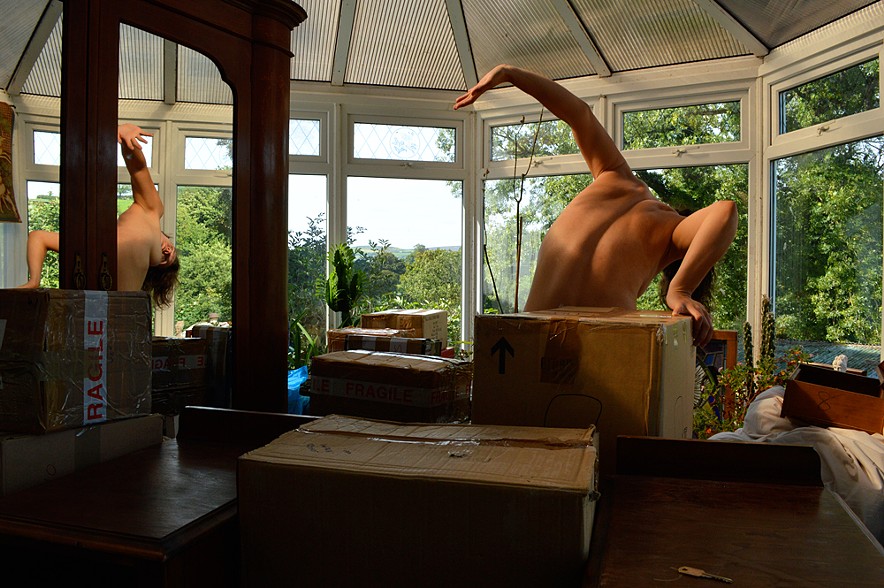
Robyn LeRoy-Evans

Artist working with the human body, objects, spaces... ever in search of the erotic.

Untitled (back), 2013

"My work is underpinned by my fascination with, and personal understanding of, eroticism. I see the creation of my images as a private act, one that allows me to access parts of myself that are normally kept buried. I work to stimulate my viewer by using my body, and the objects that surround me, to generate physical, emotional, and psychological responses to the spaces I inhabit, visit, or stumble upon.

The female form features heavily; the viewer is confronted by awkward, unusual, and, at times, disturbing postures or poses. These are bodily manifestations of my own personal fears, anxieties, frustrations, and desires. Occasionally, the female figure is signified through its absence, being represented instead by vessels or draped fabric. I wish to provoke without becoming too over-prescriptive, to arouse without overwhelming. The formal, compositional, and aesthetic qualities of an image determine its construction.

My research into erotic literature, Japanese aesthetics, and the fashion photography of Guy Bordin, inform this methodology. A pivotal exhibition for me was Angels of Anarchy: Women Artists and Surrealism (2008); it was here that I first viewed the photography of Francesca Woodman. To me, Woodman’s images demonstrate a disturbed femininity, a sort of cryptic eroticism…elements that I hope to bring into my own work.

My most recent photographs have led me to question my work and position as an artist: What are the boundaries between photography and performance? What is the significance of the headless/faceless woman? What role does the female figure play in contemporary photography? How do I feel about being at once the (female) artist, subject, and (sex?) object? Finally, what is considered ‘erotic’ today?"


Tuesday, 8 April 2014

Irena Siwiak Atamewan

Irena is an artist working with a camera and a photography educator. Following a background in Medical Photography, a clinical approach to her subjects is reflected in the style of her work; whether it's a domestic space or an urban space. She came to photography as a second career following many years of extensive travelling with camera in hand.


Urban Trees

Urban Trees: ESPY Photography Award
My work explores the homogenisation of our modern cities. The Urban landscapes in this work springs from the areas between the buildings, exploring the street furniture. Stationary objects, practical objects, giving orders, instructions and lighting the way to all who happens to pass.
Amongst this functional furniture, trees are brought in to decorate the urban landscapes, to reside on the tarmac and paving stones that covers the soil of its origin. Solitary trees in the shadow of modern urban living, its function in life to garnish and decorate in a square metre of growing space, controlled and tamed.
These images document trees in the shadow of dominating street furniture, blending nature into its man made environment. The style is a straight-on view point, breaking rules of composition and landscape photography, placing the point of focus in the middle, sometimes cutting the image in half.
This work is an ongoing project, expanding into different cities and countries.


Other projects
Presenting a series of portraits of octogenarian sisters in Sardinia. One morning at breakfast the light was just right as they sat talking and I just had to capture them in full flow. They quickly forgot I was there, this allowed me to capture natural expressions and emotions. They spent their time reminiscing, remembering and relaying stories from their childhood.
One sister lives in Sardinia and one sister lives in the UK, the last of eight siblings. The family dispersed by war, meetings were infrequent. The last time they had seen each other was eighteen years ago.
They got together for one week in July 2013, maybe for the last time.

This work explores how we use objects and spaces to give definition to our lives, these spaces could be the home, the office, the car, the shed, to name a few.  Spaces representing an aspect of ourselves, highlighting areas we would like to show and give attention. It's a human need to connect emotionally to a space.
'One of the basic human requirements is the need to dwell, and one of the central human acts is the act of inhabiting, of connecting ourselves, however temporarily, with a place on the planet which belongs to us and to which we belong.
Charles Moore, School of Architecture: Foreward. In Praise of Shadows. J.Tanizaki 2001 Vintage


New Work
After the Chemo
For as long a I remember my sister had a beautiful print by Giovanni Ambrogio de Predi, the painting is of a woman in profile.  This was the inspiration for this portrait. 
During my sister’s chemo treatment she wore a series of hats and combination of hats, which I felt took on the shape of a headdress worn by women in the era of the painting.  Combining the beautiful window light and my sister’s strong profile, I wanted to capture the strength of surviving and looking beyond the treatment.


I want to create a body of work photographing women undertaking or finishing chemotherapy, wearing a variety of headwear, scarves, hats, wigs etc. then photograph them in the style of Italian Renaissance Portraits, where the women in these paintings are beautiful and elegant in their head wear and hair styles. This is the first image in the project and I am in the process of finding other people willing to be photographed.

When I collect enough portraits, the work will eventually be made into a book and the proceeds of the book will go to cancer charities.

______________________________________________
_________________________________________________
  • Photography MA 
  • Post Graduate Certificate in Education (PGCE) 
  • Photography BA (Hons)
  • Selected for ESPY Photography Awards Exhibition: Elysium Gallery, Swansea. 7th – 29th March 2014
  • Photographer’s Profile invite: Lens Culture 2014
  • Altrincham Arts Festival, October 2013
  • Source Magazine, MA Online Showcase, 2012
  • Book Showcase Brighton Biennale, August 2012
  • MA Show. Manchester Metropolitan University. 29th September – 6th October 2011 
  • MMU Masters Showcase, 52 Princess street, Manchester 17th July 2010 
  • Eye to Eye, Open Eye Gallery, Liverpool. 22nd July - 24th July 2010
    - Resulting in the publication of 'Eye to Eye' Book in collaboration with The Open Eye Gallery, September 2011
  • 50x50 by Slaughter House Studios, Holden Gallery Café, Manchester Met Uni. 25th November 2010
  • MMU Masters Showcase. Hotspur Press, Manchester.  14th - 18th October 2010 
  • Curated and contributed to Photography Exhibition 'Challenging Concepts (Aesthetics of the Body)' showcasing the work BA students, in Lahti Finland as part of the Aesthetics in Practice Conference.
    The work continued at The Broadway Art centre Nottingham. 1995
  • Curated and participated in "Signals: Festival of Women Photographers", a group exhibition 'Girls on Film', Observatory Gallery, TNTU Nottingham, England, 1994
  • Joint Exhibition: Jill Regan / Irena Siwiak: The Anatomy of Risc / Monuments of the Past, or Signposts to the Future? Observatory Gallery, TNTU Nottingham, England, 1994
_______________________________________________________________________________________________

Sunday, 6 April 2014

Welcome to The Prefab Museum

The Prefab Museum
17 Meliot Road, Catford, SE6 1RY

The Prefab Museum, opened on March 8th, is a resounding success!  In just two weeks, the museum has attracted more than 700 visitors! Thanks to the TMO (Tenants Management Organisation of the Excalibur Estate) and our lovely volunteers, the Prefab Museum will stay open until May 31st!

See the special wall of Jane Hearn’s photos, where Excalibur residents, past and present, can take away a framed photograph of the prefab they live or have lived in!


Elisabeth Blanchet is available for interviews

Follow Prefabs - Palaces For The People on Facebook for photos, films, updates and events

Wednesday, 2 April 2014

The People's Prize Winner - Chris Rhodes


Elysium Gallery and Espy Photography Award are pleased to announce Chris Rhodes as the People's Prize winner!


Frón, 2012
"My initial photography years were spent traveling around coastal England documenting county boundaries and the invisible lines that divided each metropolitan borough. During this journey my eye became drawn to the homes that were occupying these somewhat remote areas of the country. Since then the thin line between rural and urban settlements began fascinating me.

For this project ‘Frón’ I travelled to Iceland, one of the most remote Islands in Northern Europe. Iceland is surreal and somewhat unique in its peculiar mix of urban and rural culture. Its inhabitants have very much adapted to the hostile environment, living off fishing and agriculture, creating urban living situations within rather harsh elements.

The majority of Iceland’s population is found in the capital Reykjavik, housing two thirds of the country’s inhabitants. Circling Iceland is the national road Route 1, which connects the higher populated areas of Iceland. This road was only finished in 1974 and is the only road accessible for regular vehicles. It has therefore allowed for a faster development around the country and permitted a journey to the more remote towns, in order to see how there settlements differ from those I photographed in England.

Driving from Reykjavik with no real plan, I simply followed the only road I could follow. As soon as I as I had left the city it felt like landing on an undiscovered new world.

The title of the series, ‘Frón’ derives from the Old Norse word meaning ‘Land’. It serves the images by referencing back to the development of the country itself in both its cultural and visual character.

Indeed, each Icelandic construction reminds us of the history of the country: a land where Vikings settled in, and thrived to survive, only after one of them dreamt of an unexplored island, left to be conquered.

Cabin
(winning image)

There, constructions seem modern but not necessarily built to last, recalling the purpose of the first settlement. Houses are built in a very similar style throughout Iceland, wood frames clad with wood or metal. The tradition of painting houses in bright colours came from a lack of money: the untreated clad metal would rust without paint and the cheapest paint available at the time was left over brightly coloured ship paint,

The buildings are somehow ambiguous to our eyes. Tradition has carried forward to the modern day meaning the houses have unique character. The simple lines, colours and construction of these buildings allow for interesting, sometimes absurd, compositions. Our instinctive imaging of the place leaves us puzzled. Each town, in the form of early settlements, hosts the most necessary constructions of civilisation. Even the smallest villages, will provide the comfort of a church, a farm, or a harbour. Are we walking through the homes of people surviving within and from their land, or are we in the presence of a very basic but organised urban culture developing in unexpected areas?

The house is one of the most personal and strangely intimate details of a person. Photographed at a respectful distance, it allows the viewer a completely voyeuristic but personal and unassuming view of the inhabitants. A house tells a story, it lives and breathes with the occupants. It’s man’s earliest form of shelter. To me the creation of a home within a harsh wild environment is really what recalls the notion of ‘home’: as the origin of the settlement of humans within a great and powerful nature they can’t measure themselves with. It is to remind the 18th century philosophy of the sublime as the space to contemplate nature and understand how its infinity relates to men.

The 5 images selected from my series ‘Frón’ aim to embody the ambiguity of a land facing modernisation but effortlessly recalling its origins, in the visual aspect of its development and the unique feel of its unusual environment. These documentary images reflect mans ever present effect on the landscape creating possible urban spaces in the most rural type of environments, where even in the remotest parts of the world, Man is still present and surviving the roughest conditions, anxious to own the land."